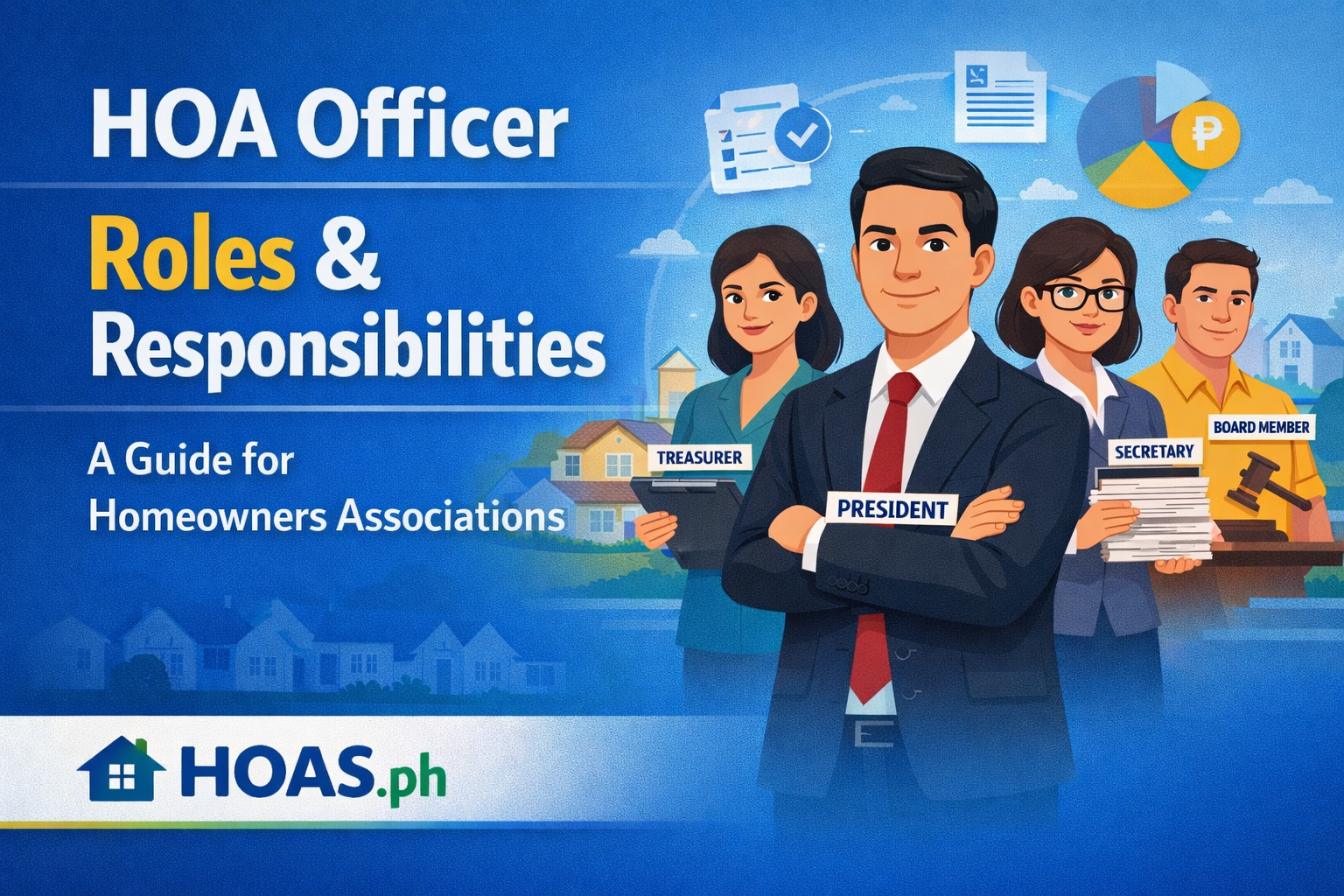
Homeowners Association (HOA) officers play a critical role in maintaining order, transparency, and harmony within a community. Whether serving as President, Treasurer, Secretary, or Board Member, each officer has defined responsibilities that help the HOA function effectively.
This guide explains the key roles and responsibilities of HOA officers, based on common practice in the Philippines and aligned with Republic Act No. 9904 (RA 9904).
Why Clearly Defined Roles Matter
When HOA officer roles are unclear, communities often experience:
-
Mismanagement of funds
-
Confusion in decision-making
-
Conflict among officers and homeowners
-
Lack of accountability
Clear role definitions ensure:
-
Proper division of duties
-
Checks and balances
-
Transparency in operations
-
Better service to homeowners
Common HOA Officer Positions
While exact titles may vary depending on the by-laws, most HOAs have the following officers:
🏛 HOA President
Primary Role:
The President is the chief executive officer of the HOA.
Responsibilities:
-
Leads the HOA and presides over meetings
-
Implements board and general assembly resolutions
-
Represents the HOA in official transactions
-
Signs contracts, resolutions, and official documents
-
Ensures compliance with by-laws and laws
-
Oversees overall HOA operations
The President should act in the best interest of the community, not personal interests.
🧑💼 HOA Vice President
Primary Role:
Supports and assists the President.
Responsibilities:
-
Assumes the President’s duties in their absence
-
Helps supervise committees and projects
-
Assists in policy implementation
-
Performs duties assigned by the board
The Vice President ensures continuity of leadership.
📝 HOA Secretary
Primary Role:
The official record-keeper of the HOA.
Responsibilities:
-
Prepares and records minutes of meetings
-
Maintains official HOA documents and records
-
Handles correspondence and notices
-
Keeps updated lists of members and officers
-
Ensures proper documentation of resolutions
Accurate records are essential for transparency and legal protection.
💰 HOA Treasurer
Primary Role:
Manages the HOA’s finances.
Responsibilities:
-
Collects HOA dues and assessments
-
Maintains financial records
-
Prepares financial reports
-
Manages bank accounts and disbursements
-
Ensures funds are used according to approved budgets
-
Presents financial status to homeowners
The Treasurer must uphold accuracy, honesty, and transparency at all times.
👥 HOA Board of Directors / Trustees
Primary Role:
The board sets policies and provides governance.
Responsibilities:
-
Approves budgets and major expenses
-
Creates and enforces HOA rules
-
Passes resolutions
-
Oversees committees and officers
-
Represents homeowner interests
Board members should act collectively, not individually.
🧩 Committees (If Applicable)
Some HOAs form committees such as:
-
Finance Committee
-
Maintenance Committee
-
Security Committee
-
Events or Community Relations Committee
These committees assist officers and report to the board.
General Responsibilities of All HOA Officers
Regardless of position, all officers must:
-
Act in good faith and with integrity
-
Avoid conflicts of interest
-
Follow by-laws and RA 9904
-
Maintain transparency and accountability
-
Serve the community, not personal interests
HOA officers are fiduciaries, meaning they are trusted to manage affairs responsibly.
Term Limits and Accountability
HOA by-laws usually specify:
-
Term length (often 1–2 years)
-
Eligibility for re-election
-
Grounds for removal or replacement
Regular elections and reporting ensure accountability to homeowners.
Common Challenges Faced by HOA Officers
-
Volunteer workload and time constraints
-
Manual record-keeping and spreadsheets
-
Handling delinquent accounts
-
Managing homeowner complaints
-
Maintaining transparency
Clear processes and proper tools can significantly reduce these challenges.
Supporting HOA Officers Through Better Systems
After elections, officers must manage:
-
Member records
-
Billing and collections
-
Statements of Account (SOA)
-
Financial reports
-
Announcements and documentation
Using a centralized HOA management system like HOAS.ph helps officers:
-
Simplify record-keeping
-
Automate dues and SOA generation
-
Track payments accurately
-
Improve transparency for homeowners
This allows officers to focus more on leadership and less on manual work.