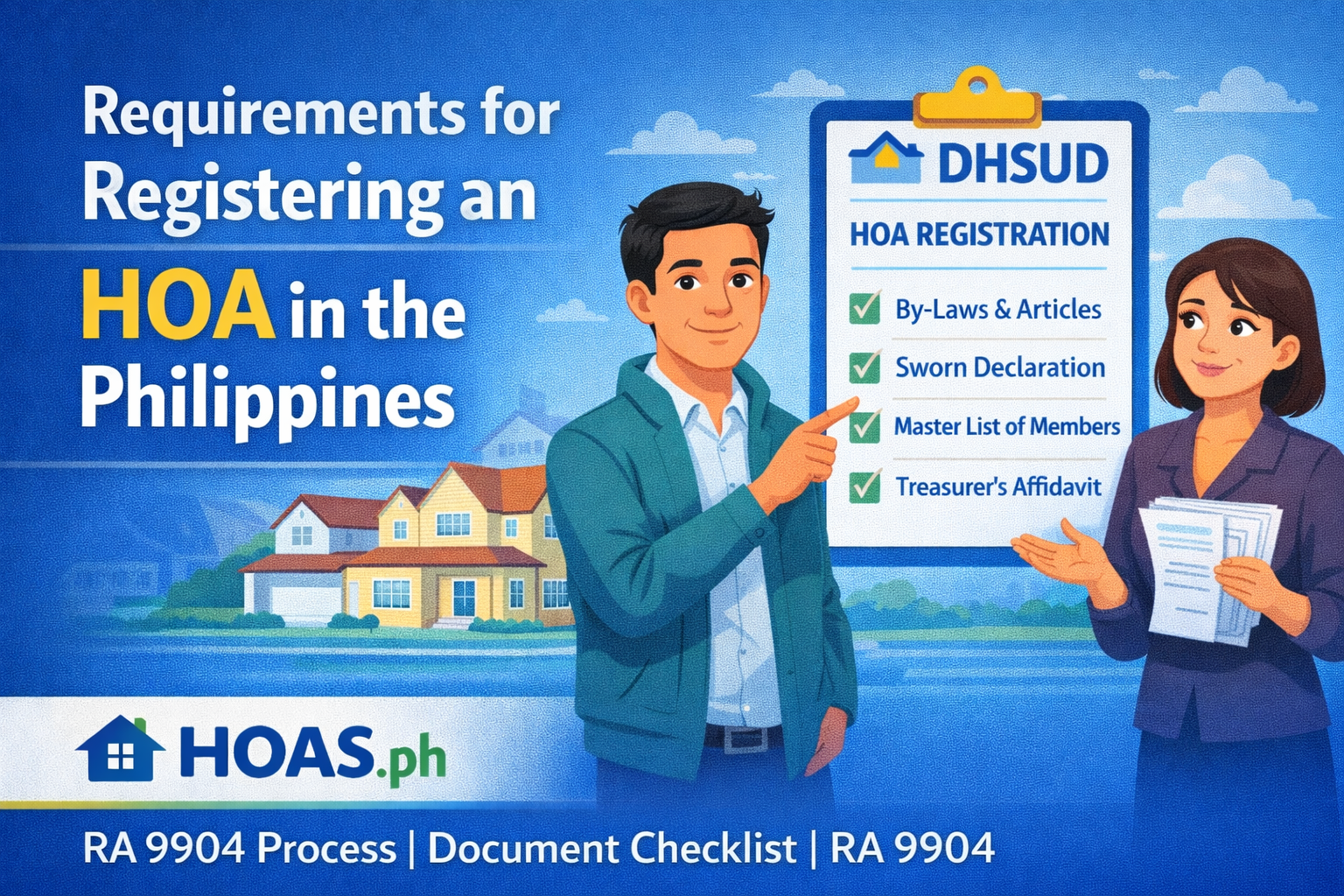
Registering a Homeowners Association (HOA) is a crucial step for any community that wants to operate legally, collect dues properly, and represent homeowners effectively. In the Philippines, HOA registration is governed primarily by Republic Act No. 9904 and administered by the Department of Human Settlements and Urban Development (DHSUD).
This guide explains the key requirements for registering an HOA in the Philippines, especially for new subdivisions and emerging communities.
Why HOA Registration Is Important
A registered HOA gains:
-
Legal personality and authority
-
The ability to collect dues and enforce rules
-
Recognition by government agencies and banks
-
Stronger protection for both officers and homeowners
Without registration, an HOA may face disputes, collection issues, and lack of legal standing.
Where to Register an HOA
Most homeowners associations in the Philippines should register with the DHSUD (formerly HLURB), not the SEC.
DHSUD registration applies to:
-
Subdivisions
-
Residential communities
-
Condominiums (for HOA-related associations)
⚠️ Important: Registering an HOA with the SEC instead of DHSUD is a common mistake and may cause compliance issues.
Basic Requirements for HOA Registration
While requirements may slightly vary by DHSUD regional office, the following are commonly required:
1. Articles of Incorporation / Association
This document defines:
-
Name of the HOA
-
Address of the association
-
Purpose and objectives
-
Term of existence
The HOA name must be unique and compliant with DHSUD naming rules.
2. By-Laws of the HOA
The by-laws outline how the HOA operates, including:
-
Membership rules
-
Duties and powers of officers
-
Election procedures
-
Meeting schedules
-
Collection of dues
-
Penalties and disciplinary actions
By-laws must align with RA 9904 and DHSUD guidelines.
3. List of Members
A certified list containing:
-
Names of homeowners
-
Addresses or unit numbers
-
Signatures of members
This proves that the HOA represents an organized group of homeowners.
4. Minutes of Organizational Meeting
This document shows that:
-
Homeowners agreed to form an HOA
-
Officers were elected
-
By-laws were approved
Minutes should be signed by the presiding officer and secretary.
5. Board Resolution
A resolution authorizing:
-
The registration of the HOA
-
The designated officers to transact with DHSUD
This confirms official approval from the board.
6. List of Elected Officers
Include:
-
Names and positions (President, Vice President, Secretary, Treasurer, etc.)
-
Term of office
-
Contact details
7. Developer’s Certification or Clearance (If Applicable)
For new subdivisions:
-
A certification from the developer may be required
-
This confirms the status of the community and HOA organization
This is especially relevant during developer-to-HOA turnover.
8. Vicinity Map or Project Identification
Some DHSUD offices require:
-
A map showing the location of the subdivision or community
-
Basic project details
9. Notarization of Documents
Most submitted documents must be:
-
Properly signed
-
Notarized
Incomplete notarization is a common cause of application delays.
10. Payment of Registration Fees
Registration fees vary depending on:
-
Size of the HOA
-
DHSUD regional office
Always request an official receipt.
After Submission: What to Expect
Once submitted:
-
DHSUD will review documents
-
Clarifications or corrections may be requested
-
Upon approval, a Certificate of Registration is issued
Processing time varies but usually takes several weeks.
Common Mistakes to Avoid
-
Submitting incomplete documents
-
Using outdated or non-compliant by-laws
-
Registering with the wrong government agency
-
Lack of member approval or signatures
-
Poor documentation and record-keeping
Preparing documents carefully saves time and prevents rejection.
Keeping HOA Records Organized After Registration
Once your HOA is successfully registered, the next challenge is maintaining organized records and operations. This includes:
-
Updated member lists
-
Officer records and resolutions
-
Monthly dues and billing
-
Statements of Account (SOA)
-
Financial reports and transparency
Many newly registered HOAs struggle with manual spreadsheets and scattered documents, which can lead to errors and confusion over time.
This is where using a dedicated HOA management system can be helpful.
HOAS.ph is a Philippine-based HOA management platform designed to help associations:
-
Manage homeowner and property records
-
Generate monthly dues and SOAs easily
-
Track payments and balances
-
Improve transparency through a homeowners portal
Using a centralized system early on helps newly registered HOAs build good governance practices from day one.